

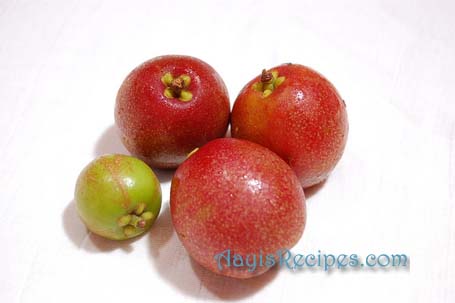
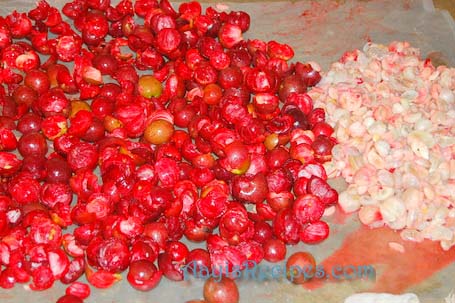
Garcinia Indica or Kokum(called ‘bhirnda‘ or ‘bhinda‘ in Konkani, ‘murugala hannu‘ in Kannada) can be called as one of the most used ingredient in Konkani cooking. Almost every household at our native and Goa has a Kokum tree. I was very lucky to go to India during kokum season this year. So I took the opportunity to take pictures of this beautiful fruit. The seeds of the fruit have a white colored fleshy coating on it. When the fruit becomes very ripe, its color changes to a bit transparent. The inside of the kokum fruit looks like following.

An average kokum tree bears hundreds of fruits during summer. When they are tender, they are green in color. As they ripen, they get the beautiful purple color. The fruits are plucked when they are ripe. The outer purple skin and the inner seeds are sun-dried separately. The skin, bhirnda sol, is used in cooking as a souring agent and the seeds are used to make bhirndel tel (kokum oil/butter).


I have got very fond memories of playing under this tree while growing up. My brother, I and few of our friends would go to our neighbor’s rice mill, which had a big backyard full of mango, cashew and kokum trees. We all would climb the tree or throw stones at the tree to pluck the ripe fruits. We would eat most of it there itself and carry few to home. Another memory which is linked with kokum is of spending summer holidays at my grandfather’s home in Sirsi. A person, whom everyone fondly called as ‘Adavi raja‘ (forest king) would come to sell these fruits. My grand parents would buy the fruit from him for us.
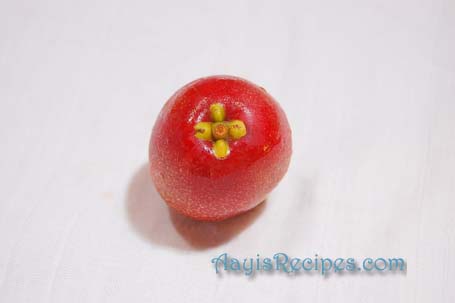
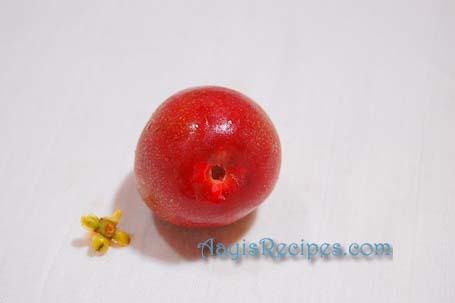
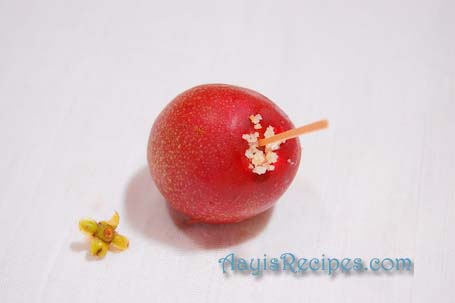
Our favorite way of enjoying the ripe fruit was to eat it with salt. Carefully take out the tiny cap of the fruit, which would leave a hole on the surface. Then with the help of a toothpick, push some salt crystals in the hole. Insert the toothpick in the hole and rotate it few times to mix the salt with the seeds of the fruit. Now suck the juices through the hole. Ahhh..its heaven. Only those who have actually tasted this can understand the sheer pleasure it gives. Once all the juices are done, break the skin into two and pop the seeds one by one in the mouth :). Discard the seeds. This was our favorite fruit to eat(only after mango) during summer vacations.

The most popular dish prepared with fresh kokum at our place is kokum kadi. A sweet, spicy and sour drink with a ingale(charcoal) or mustard seasoning. As kokum has cooling effects on the body, this is the perfect drink for hot summers.

Bottled/canned kokum syrup is available in many shops in Goa which acts as replacement for the fresh fruit to make the kadi. Another version that is very popular is sol kadi, prepared with fresh coconut milk.
The skin of the fruit – which is normally sold as ‘kokum’ is sun dried in large quantities to be used when the fresh kokum is not available.

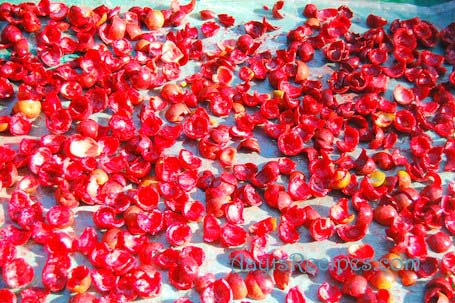
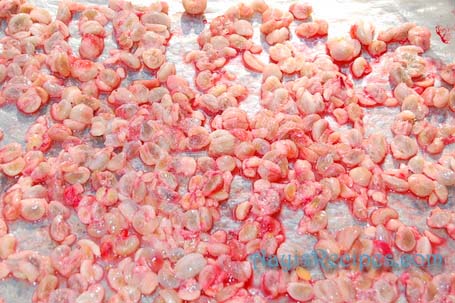

Some salt crystals are added to the dried kokum, which acts as a preservative. As days pass, the dark purple skin turns black. When soaked in water for some time, the skin leaves beautiful purple color. This has many medicinal properties. The skin is soaked in water for sometime and the purple colored water is given to the patients suffering from ‘pitta‘.
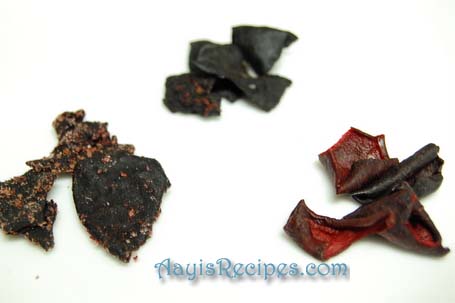
Sometimes the fruit is mixed with sugar and sun dried. The juice that comes out of it is preserved to make kokum juice.
The seeds are sun dried to make kokum butter (bhirndel tel). The outer black shells of the seeds are peeled and the inner white colored seeds are chopped and ground into fine paste. Then they are cooked and dried to get the butter. The butter retains its solid shape at room temperature. When needed, it is held near a flame to melt it. This melted oil is applied to cracked heels and dried skin, which acts as a very effective moisturizer. Before we were introduced to different moisturizer brands, we used this as a moisturizer. Even now, we use it frequently for cracked heels.


Welcome back! And a lovely post! Wow! You brought back many memories, I have to tell you! And that kokum butter was my friend for years! My parents believed that it ‘cooled’ the eyes when rubbed on the feet. I don’t know about my eyes but my feet were smooth and had no cracks!
I’ve been slow with replying to email. Will get in touch soon!
Welcome back, Shilpa. Very informative post. I have used Kokum butter till i was in India. It had a soothing affect when applied during winter and very effective for craked feet.
Hey Shilpa, welcome back!!!! 🙂 Hope you had a great vacation… missed you!
Thanks for this Kokum post, this really clears up the kokum vs kudampuli debate, they don’t look anything alike… 🙂
Welcome back! Missed u…i never realized that I am addicted to your site, untill u took a break…
I never knew about kokum butter, we have Kokum tree at our native, I think no one in my family is aware of this feature, I will inform them, they may try it…. thanks for this information.
That is a great post…all illustrated wonderfully well 🙂
the kokum fruit is just gorgeous. welcome back.
Welcome back Shilpa,
Happy to see your post. You are so good at this. I have never seen a kokum fruit that is red it is very pleasing to my eyes. By the way I made the date cake(eggless) from your site and may I tell you it was out of this world delish. All my friends and their kids loved it too. Tell your pachi thanks too. I prefer to use the Mejdool dates from Costco for the cake. Thanks again for a great cake recipe for all of the vegetarians out here.
Hey Shilpa,
Welcome back.Missed you!!As someone said rightly,never realized I was addicted to aayisrecipes until you took a break.Hope you had a nice vacation.Looking fwd to more of your aayis recipes!!
Divya.
Welcome back… What a lovely post to restart your blogging! We get our stock of binda sol from Goa every year… I hadn’t heard about the oil till now. Must check with my mom. Besides souring the curries, we add it while frying Bhindi as it is supposed to prevent the stickiness.
Welcome back Shilpa! hope u enjoyed yr vacation in a great way…. looking forward to see yr nice receipies..
Welcome back, Shilpa. Your back with a bang with a beautiful post on Kokum. Wasn’t aware of the immense medicinal value of kokum. I can relate to your childhood summer vacation memories.:)
Hello Shilpa,
Thanx for all that gr8 info. Welcome back…Looking forword to newer recipes from you….
Ohh Shilpa……Kokum is my favourite fruit both fresh & dried! I love everything prepared using it. This post has brought back so many fond memories. Thanks.
Hi Suma, did you ever live in madurai?… am actually looking for one of my friends. Thanks
Yes I did
Welcome back, Shilpa. What a glorious and informative post this is!
I fruit looks beautiful. I for sure have never seen it so thanks for the beautiful pictures.
Welcome back. Missed the recipes. Glad to see you back in action again.Hope all your family is doing well at home.
Hi shilpa,
what lovely photos and information. Thanks a lot I have never seen kokom fruits – till now. I am slowly getting addicted to your site, its so informative and good work, keep it up.
Rgds
Rama
Welcome back Shilpa…hope you had an enjoyable break 🙂
Great photos and very informative post. I had not heard nor seen Kokum before and I am from Bangalore.
hi shilpa,
welcome back. i was waiting for more recepies from you.
Hi Shilpa,
U took me straight down memory lane…in my primary and secondary school years, this is exactly how me and my cousins enjoyed brinda when we visited my granny in Honnavar during summer holidays. Oh, such fun days!
thanks for the joyride!
hope u had a great trip!
Supriya H
Welcome back Shilpa. Missed your recipes very much. Loved this post, I have not heard or tasted Kokum earlier. The drink looks so refreshing.
This is my fav fruit…. Looks awesome… Kadi out this!…. Never tried before…. Nice and different recipe….. Love it…
A lovely lovely post. I have not seen or tasted kokum and now I know what it is all about, at least visually.
Welcome back, Shilpa!
what a beautiful post on kokum, you sure must hv had a great time enjoying this lovely fruit 🙂
lovely info on Kokum with gorgeous pictures. Thanks for sharing.
Great post, Shilpa! I never knew so much about kokum, although i love adding it to aamtis and bhaajis.
Welcome Back, Shilpa !! Missed your posts very much.
I was in India too, but just for 2 weeks and although buying Kokum was on my list, never got around to it.
Seeing your lovely post on kokum, I now regret that I did not bring back some..
Did not know about the Kokum butter, good to know…shall tell my family about it.
I am glad that you are back and shall look forward to your interesting posts…
Hi Shilpa
I am a regular to your site these days. I have developed a passion for cooking and I would say that you are one among the ones that inspire me!! Thanks for everything that you do…
I have tried several of your receipes and the latest was the eggless dates cake, it came out great..its a keeper!!
Welcome back and I am looking forward to more of your recipes.
I ve never seen kokum. thanks a lot for such an informative post. I like the dried bits. It is possibly the only way to get them here in Europe, eh?
Welcome back, Shilpa! And thank you sooooooooooo much for such a lovely and informatiev post! You’ve captured kokum in all its beautiful and versatile glory. Thanks for making us enjoy the salted and ripened kokum fruit through the lovely pictures 🙂 Kokum butter is one of the best blessings for skin!
Welcome back Shilpa, Hope you had a great vacation.
Very Informative post. Been missing your posts, glad you are back.
Cheers
Welcome back Shilpa…. missed you a lot……….
Welcome back! Its great to have you back. What lovely pictures! I was just reading about how kokum is supposed to suppress hunger and is now touted as good for those trying to lose weight.Is this true? In Singapore we only get to see the dried kokum and it tastes quite like salty tamarind.
I truly missed you and am happy I can look forward to your regular posts. Keep it up and never never stop.
tiba
Shilpa!!! welcome back to your great job..i missed a lot all these days..hope you had nice time in inida…i never ever imagined that i can get such a great website which really gives you an interest to cook…im certainly happy with your great recipees !!!!!thank you somuch ….and i too love this kokum fruit we used to get it dry during my school days ….i really miss it…wonderfull pics….great job shilpa!!!!
Welcome back Shilpa!! What a great post, you are back with a bang :)…Hope you had a great time in India..
As a “foreigner” in Candolim Goa with a Kokum tree near where I live, I couldn’t understand all the fuss when the fruit was ready to fall last year. Now I know why from your wonderfully informative and beautifully illustrated article. I shall certainly be joining the queue myself this year & hope to get a few berries!
Welcome back – I’ve missed receiving your wonderful recipes and am looking forward to them during the monsoon months……..
thanks, it is very good article, ….. Looking forword to newer recipes from you….
Pingback: Know Kokum | DesiPundit
So is this how fresh kokum looks like? Wow!
hi shilpa..
Happy to see u back…. Kokum looks yummy.
Wecome back Shilpa.. Really missed you sweetie !!
A lovely post n beautiful pictures… Very informative!!
Welcome back! Lovely post!
I had no idea kokum fruit looked so pretty!
Love Sol kadhi and kokum sherbet! wonderfully cooling in hot weather!!
Awesome! This is wonderfully informative for me, as I have never seen photos of fresh kokum nor heard of the different ways it is used. Great post Shilpa! Thank you for sharing this.
gr8 post……your site is very informative seeing u describe i feel like eating it right there and then
Welcome back Shilpa,
What a very beautiful post and gorgeous pictures. I am a Konkani (but born in the US) who grew up drinking and loving kokum saar, kadi and kokum sherbet all my life. But have never seen the fresh fruit or knew the process by which the saali (peels) were made. So thank you so much for the pictures and the info. Made me long to go to the Kanara coast. Hope you had a wonderful vacation and so glad ur back.
Welcome back! Hope you had a wonderful trip to India. Informative post with beautiful pics! 🙂
Welcome back Shilpa. Hope you had a great trip. Never knew that kokum was a fruit. If I ever find it I am definitely going to taste it.
Great to have you back. I am resident of Mumbai and am in Seattle for last 4 weeks on work. Another 8 to go. The muggy weather here gets to you; During such times, articles like these transport me to the summer holidays spent at my maternal grandmom’s home in Honavar/Mavinkurve. Great comeback!!!
Welcome back shilpa – and thank you for such a lovely post. I would love to try the salted way of eating these… but I don’t think I will find a stickists in the UK!
WOW Shilpa you are back with a bang…. Lovely pictures and information. It looks like you were busy even there taking pictures :-). Looking forward to more recipes.
Hi, Shilpa..
Welcome back..
Wow, really its nice to see fresh kokam !! Refreshed my childhood too !! Very nice snaps !!
What a lovely post! Enjoyed reading every bit of it.
Hi Shilpa! Yaay! Good to see you are back!
and I love the Bhrinda with the salt poked into it. I used to poke thro about half a tea spoon of salt and then sit by the window slowly sucking on the juices! Yumm!
and thank you for the beautiful pics of the kokum. Haven’t had fresh Kokum in ages. But on every visit i bring back a bottle of Kokum concentrate! (nothing like the fresh thing!).
What an informative post! Thanks so much. We S Kanara people use more of bimbul as sour vegetable/fruit, even more than kokum. When the fruit was avlbl in markets we would buy them to make the dried skins but I had never heard of the butter extract.
Dear Shilpa,
I am addicted to your posts. I download each and every one of your recipes and prepare it one time or the other. Just now I bought fresh birinda from nearby grocery shop and am all set to make kokum kadi. I am originally from kerala, where this fruit is not much used. I never used to buy this or the dried skin though it is available in manipal/udupi, because I didnot know what to do with it. Thankyou once again for all your help. It is a wonder how people you never meet help you in many ways.
Welcome back Shilpa! Hope you had a blast during the vacation:) This is an *outstanding* post. Beautifully photgraphed and meticulously explained. Great job!
Sree
hi shilpa,
lovely to know u r back from vacation! Amazing article about kokum. I never really knew anything about it except that they drink this a lot in maharashtra. good work!
regards,
Veda
Shilpaaaaaaaaaa…welcome back!! My net connection lapsed more than a week back! Got an annual subs. just yest..wow..what a comeback post! I have seen this deep red ripe birinde 2 decades ago, when i was 10!! My uncle in Udipi used to add double amount of sugar to the red chopped skin, and sundry it for a week to get a syrupy texture, we wd guard it, sometimes pop the yum pcs when no one was looking :D, then we all (ie my family and cousins) wd relish the syrup with water as ‘ Amrut Kokam’ which even now has a fan in me!! Tks for this totally amazing and informative post and welcome back (Yummy blog award truly stands for you!) Kisses n Hugs!
hey Shilpa ,hope you had a great time in India….well even I have fond memories of Kokum and picking the fruits in Kodkani.
Dear Shilpa,
You are back girl! I am totally excited to see wonderful recipes you brought with you.
bhirndel tel !! Never heard of that. IS the last picture of how the buttur looks?? Amazing!
hmm..I know ..will post soon.
Welcome back Shilpa!!! I guess you had lot of fun in India.
This article took me to my childhod days, when we used to eat this fruit and our teeth would turn into yellow. I just simply love this fruit. Thanks for posting a very informative article.
Hi Shilpa,
It is a really wonderful and informative post. Do you know where will we get these kokum butter blocks that you posted. I have heard great things about it but we don’t find them in Hyderabad or atleast I have never seen them.
Thanks!!
Shilpa: Vani, they should be available in Goa and around because thats where kokum is grown.
Fantastic post — thanks for sharing such lovely memories and informative photos of all the stages of kokum! I’m definitely picking up some dried kokum next time we’re at the Indian grocery here and trying your recipe.
Hi! Shilpa welcome back. My mouth was watering looking at Bindas. I had tasted in childhood when I along with my parents was going to vacation to Manglore. thanks for this information
The photos are good & useful information is found.Thanks
Hello,
This a wonderful post that you have put up….I found it very informative..and the way you have shared your chilhood memories of it is very nice..Since I am planning to do a project on Kokum..I found this information very useful..
Thank you very much..
I have tasted this fruit a couple of times when in India. I love it next to mango & jackfruit. Is this available in USA? if so please let me know where I can find this. I live in Charlotte, NC.
Thanks, found a lot of interesting info’s and ideas.
Su Amar
Response Su Amar
I found a fruit called as Mangosteen sold at a chinese market which was remarkably similar to the Kokum fruit shown in the pictures. They tasted wonderful.
I believe its a different varitey of Kokum called Garcinia mangostana (refer: http://en.wikipedia.org/wiki/Mangosteen)
Hope this works as an acceptable substitute.
I bought a bottle of Kokam juice. I would like to know how I can prepare the drink, so that that I can drink it. I would like to know the proportions of this juice and water, and whether I can add sugar/honey etc to this juice. Please let me know.
Hi,my name is nisha,I wana know where can I buy kokum in USA.Can you pls tel me I will appreciate.thanks.
Pingback: Tempting! Links to Delish Dishes and Handy Hints. « A Life (Time) of Cooking
Pingback: curried concoctions « Signature Concoctions
Dear Shilpa,
In Singapore we call this fruit mangosteen.
Simply love your recipes !!!
Hello
I recently had squash foogath and was able to obtain the recipe. It calls for “wet kokum – seeded and cut into strips”. Is this calling for kokum fruit?
Thanks
Shilpa: No idea :(. Sorry.
I went to Jamaica a few years ago and saw tree and a fruit similar to this. They call it Ackee, the national fruit of jamaica. It is cooked (to my surprise) as a meal as oppsed to eaten raw. The meal I had was more like a salty scrambled egg. I was just curious if it the same or similar?
It would be very useful to avoid all sources of confusion if the scientific/botanical name of a plant can be given. In this case, Kokum is botanically known as Garcinia indica (Family Clusiaceae). The plant is native to the Western Ghats region in India. It is also known as Bindin, Biran, Bhirand, Bhinda, Bhrinda, Brinda, Kokum, Katambi, Panarpuli, Ratamba or Amsol in Indian names and in English as Mangosteen, red mango or wild mangosteen.
welcome back . s.miss you
hi shilpa,
Mouth watering pictures. I am too great fan of bhinda, sola curry. I was eating this fruit without salt and still it was delicious. Thanks for the beautiful pictures. Whereas bhinda is not available in Mumbai bhazar. Thanks once again for yr great work.
Shilpa, you have refreshed my childhood memories. I am from Goa & we have many bhinna trees. As a child, even I used to make a hole in the bhinna, put salt in eat, roll it with a match stick & sip the sweet & salty juice.
Thanks,
Rgds,
Philo
It is a great aarticle about a fruit which is not known much outside its region of occurrence. I have been visiting Konkan, Malvan areas andd therefore I know it. Secondly I have alwaays been interested in wild growing and lesser known fruits.
I shall like to get in touch with Shilpa, the writer of this article.
So I request Shilpaa to kindly contact me by e-mail.
Dr. Chiranjit Parmar
Author of the book: Wild Fruits of the Sub-Himalayan Region –
Pub. 1982
Author of CD: Some Wild Grrowing Fruits, nuts and Edible plants of the North West Himalayas – Published – 2008
Editor-Coodinator: http://www.fruitipedia.com
what do you call kokum in english could plese tell me
Shilpa: Kokum IS the English name for this fruit.
Oh my God!Shilpa u just made my day today as i was browsing your site today as usual after work,i found this post,you brought my childhood memories back.I am in Dubai since 4 yrs and each yr i miss Goa all the more,your site helps me to keep in touch with all the konkani recepies which i try at home and they always come out great.Thanks to u,pls keep posting your recepies as i am a regular visitor of your site.i remember making holes in the kokum fruit and eating it the exact way u described,and also remember the fingernails turning yellow when you take the seeds out from the fruit to dry the skin to make sola..Anyways looking forward for more post….i havent gone thru all of your recepies as yet..but i will surely one day..
Hi Shilpa ,
This kokum fruit has many medicinal value..
Where can i get this fruit extract in Chennai?
and how to use this extract ?
is there any idea to you , please mail me about this you knew Shilpa.
Thank you
Shilpa: Sorry, I don’t know.
Hi Shilpa,
Iam new to your website and i’ve been a silent admirer. This site, i must say is one of THE best in the internet world. I’ve browsed almost all your receipes and have tried a few and yay, it comes out very well 🙂
I have 2 questions..
1. I stay in California, and where can i get the kokum extract?
2. How to cook brown rice in pressure cooker? I’ve tried a few times, with very less water (like 1 brown rice and half cup water) and 8-10 whistles. I have also heard people say that it shud be cooked like idlis(without putting the weight on the pressure cooker’s lid) What is the optimal way to cook?
Thanx in advance and kudos to you for such an impressive food blog!!
Shilpa: Sorry, I don’t live in CA. So no idea. I have never cooked brown rice, so don’t know.
Hi Shilpa,
I had seen the yellow fruits in M’lore and first time seeing the ‘red’ ones here… I am guessing both are same.
Beautiful article!!!
Hi shruti,
yellow fruit is jarige used dry the skin ,red is punarpuli (mangosteen or Garcinia indica,.iam from udupi we used jarige for fish curry , we used kokum to punarpuli saaru,or juice for drinking.we used to eat fruit too.
Shilpa, thank u so much for uploading perfect pic of kokum exactly we used to dry under the sun.recalling the memory.i live in boston ma
Shilpa, you have put up a very informative post. Thanks!
@Priya/anyone else: If you happen to have found out where in California can you buy Kokam/its extract, will you please let me know (itsleogmail). Thanks!
i wanna know the exact recipe 4 making kokam syrup , could u plz send me @ odelia93@gmail.com
shilpa,
I found kokum sherbat in a nearby shop and that gentleman has stock of kokum too. Should they be directly added to dishes or as tamarind.I am going to buy it and try all recipes you have posted with kokum. It was very nice to see the fruit in your garden. MY friend amruta has already introduced kokum to me but i was not so particular about consuming them> your pictures have tempted me now.We eat a similar fruit called mangosteen, must be the same family. Pl tell how to use kokum, Thanks a lot
Shilpa: Yes, it is directly added to the dish.
very lovely pictures. We are going on a vacation to ratnagiri – ganapatipule. hope i can buy some fresh ones there. your pictures made me put it on the top priority of shopping list.
Hi !
I am located in Chennai (Madras) and I have farm land in Thanjavur Dist..
I would like to have the seeds of this “Kokum Fruit” to plant in my farm…
Can you send it to me please?
Thanks…
Irfan…
Hi Shilpa,
I just simple love your site both receipes and art campus.
Also its not only me but many of my friends are also big fan of aayis receipes.
Could you please post receipe of kokum juice or kokum sharbat when ever you prepare it.
Thank you very much.
Shilpa
Hello,
We have been recently been told to have ‘kokum’ instead of sour products for health reasons.Could you please tell us how to use kokum,what to use and what to discard!!
We would appreciate a few recipes as well including the ‘kadi’.Hope you can oblige!
Many thanks.
Regards,
Dalu Patel.
Dear Shilpa,
Investigated on Kokum and found your interesting information on it. Thank you.
I live in Hamburg. We made holidays in Goa last week and I bought a packet of dried Kokum at a shop in the airport. Heard of Kokum and got the red lila juice on the breakfast buffet in our Panjim Inn.
I wonder how the dried Kokum could be integrated in any dish? Similar to using tamarind? Will have to check out more of your infos or if you would reply on this?
If Kokum is Mangosteen? I know mangosteen from Indonesia. The ripe fruit has black and thicker shell and it is usually of no use. Only the marvellous white fruit inside is to be enjoyed. Could Kokum be a wild mangosteen?
Thank you again for the story on your experience with this fruit. I could imagine the memories. I am happy to have bought the packet of dried kokum, firstly just for a try.
Best regards, Rita
No, Mangosteen and kokum are not same. I think they are very similar. You can directly add it to gravies/curries as souring agent, no need to soak in water.
Hi Shilpa!
Truly informative. I was trying to find what to do with these fruits from our plantations in Wayanad, kerala, that has some trees of what we only knew as “Kokum” or “Punara puli”. would you or anyone here know where we can sell our produce? Also are there any buyers for raw fruit?
Thank you!
sanjay
Sanjay do you have kodum pulli or kokum?
I am interested in kodum pulli so do let me know if you have Kodum pulli
Thanks
Hi Sanjay
As you are having the trees with fruit, why not sell me a 200g of dried Kokum, Kokum butter and Kokum seed.
Thanks
Ann
reallllllllllllly nice snaps …………it refreashed my childhood sooooooooooooo coooooooooooollllllllllll
hi, i wud like to have the kokum syrup recepie n how to store without preservatives. can anyone help. i have a big tree n have lots of kokums. i wish if someone helps me with this recepies.
thanx Nisha
Cut the kokum and add same amount of sugar. Keep it under direct hot sun. It leaves syrup. Drain the syrup every day and keep under sun for 7-8 days.
Thanks for informations and beautiful pics of Kokum. I reside in Chhattisgarh state in India.I had been to Goa Twice. One when I was a kid and the other in the ear 2007. I am suffering from Gastic problem ( severe problem). While reading the posts, I came to know that Kokum is useful for controlling Gastic and Acidity problems. Since I reside very far away from Goa, I am not able to get her. Would you please provide me some addresses f shops in Mumbai from where I can purchase? Also please tell me Is dried Kokum is useful or not?
Can u tell me the kokum that they use in kerala n the one tat they use in maharashtra is the same?They call it kokum but i feel that the taste and smell of the kerala kokum is very strong.
I guess they call it kodampulli also.I am from maharashtra. Was wondering i the kokam curry that we make will taste good with this.
No, both are not same. Read here for kodampuli
Thank you for supplying such splendid information about the Kokum fruit I live in Thailand and need something to cool down my system, unforunately we do not have the kokum fruit here. What to do???
Sweating for an answer!!!!
Kind regards
Angela Lawrence ( English )
Hi Shilpa, thought you might like to know- They’ve used your photographs here-
http://hubpages.com/hub/Uses-of-Kokam-a-purple-berry–botanically-known-as-Garcinia-Indica
Thanks for letting me know
my husband too used to eat these when he was small and he used to describe them to me and how he enjoyed it.since i was bought up in hyderabad i never got a chance to see it in this form. i have seen it in the dried form since i use it for cooking. thanks for posting its pictures.
good info for people who havent seen kokum or its trees or fruits in fresh form liked the pictures very much thanks shilpa for posting them shabana
Great article and pics, thanks! 🙂
While walking my dog in a park I came across a grassy area covered with 100’s of these fallen red fruits. I was tempted to try one but my friends said it’s most likely poisonous as no birds, squirrels, etc were eating them.
I took two home, photo’d them, did some googling and found myself here 😀 I’m pretty sure it is the same – except maybe a different genre? As mine are more radish shaped – pointier bottom/knob at the bottom. Could you please tell me if you think these are Kokum / Garcinia indica? The photo is here:
http://s3.postimage.org/v6sekedz/kokum.jpg
Thank you
PS: I was too tempted to wait and took ate a tiny one – sour deliciousness – wish me luck hehe
No, this is not kokum.
No, that is definitely not Kokum. Looks more like a Jarige – which is also dried & used as a souring agent. There is another fruit that looks like it. Called Anturaala in Kannada i think, which is not edible.
There are other fruits that look like it as well. Take care, do not eat because they may not all be edible.
Hello Shilpa,
Does this Kokum has any other name in Hindi ? I want to get this from the market in Delhi….where will I find it.
The details of recipes given by you are really good. I love cooking and will certainly try your recipe but first I have to find this in Delhi.
Give me a name which a grocer will understand if Kokum is not the popular name.
Thanks
Kind regards
Sorry, no idea.
1. You will always get kokum in Kerala Emporium, Baba Kharak Singh Marg, New Delhi. Near Connaught Place. If the staff does not understand kokum, ask them the spice, which looks like tamarind, (imli), but is different.
You can also try the emporia of Maharashtra, Goa and Karnataka.
2, In Munirka, there is a shop, Rama Krishna Store or something similar. When one travels from IIT to the airport on the Outer Ring Road, after passing most of Munirka village on the left, one by-road to the left leads to Vasant Vihar, Priya theatre etc. (On the other side of this road is Vasant Vihar DTC Bus Depot.). One does not have to cross over towards the depot. Just short of turning to the left towards Vasant Vihat, at the corner, you will find this shop, selling South Indian products.
The staff there does understand kokum!!!!
The shop, I tend to remember, is closed on Tuesdays.
Kokum is also known as aamsul.
YOU CAN USE “KUDAMPULI” INSTEAD OF KOKUM.
yes, this is kokum and is fun eating them.
This looks very much like what is called mangosteen in Malaysia where it is called the ‘queen of fruit’. Is it the same? We ate the pulp but I never saw a local person use the skin or seeds.
As far as I know, they are different. They are from same family though. Here is wiki page for mangosteen
Hi,
Shilpa, thanks so much for this post. Not only did I find it informative with the information and pictures you included about kokum, but I thoroughly enjoyed the memories and stories you shared.
I am a European living in the States, and reading things like this allows me to understand the flavors, colors, and nuances of why so many of my Indian friends just long to return back home!
At any rate, I have been looking up kokum because I read about it in a book written by an Indian scientist about Healing Spices.
Kokum is believed to have several healing properties, which include fighting cancer, help with ulcers and the bacterial infection H.Pylori, protection of brain cells and great antioxidant properties.
Apparently, kokum has been used by Ayurvedic physicians to treat sores and prevent infection, improve digestion, stop diarrhea and constipation, soothe the sore joints of rheumathoid arthritis, cure ear infections, and heal ulcers.
It is not easy to find, especially here in the US, but I read that it goes by these other names: kokam, kokkum, fish tamarind, mangosteen, wild mangosteen and red mango.
Finally, the depiction of the plant looks very similar to the picture of the tree in this blog entry.
Thanks for sharing. I have a renewed appreciation for what your beautiful country has to offer (vegetation, people and lifestyle!).
Cheers,
S.
Shilpa, please tell how to prepare kokum juice from fresh kokum.
Kokum juice and rasam are favs at home.
Nice to see these pics and read so much about Kokum. Thanks 🙂
Thank you for the info about the Kokum. I have had the juice a few times, but in Goa they made it very garlic-y. I’ll buy the fruit in Bangalore if I can!
Hey Shilpa,
Found this post very informative.Actually i have a project in my hand about Kokum butter-extraction,to be precise. So could you please elaborate more on extraction procedure.It would be really helpful.Thanks for sharing your fond memories btw.Awaiting your reply.
Thanks
Ilena, I have posted everything I knew about the kokum butter. I haven’t done/seen it myself. Sorry
Thank you again Shilpa. Keep sharing your experiences. Take care
Hi,
I was reading a article about refreshing drinks in summer and came across this Kokum. When I did a search, it gave the link to your site. I have visited your site couple of times(since I am also from Karnataka) I knew i would get correct info as I can relate easily.
Currently I stay in US and planning to visit India, I wanted to know where I can get this fruits(ripe or dried) in Bangalore.
Can you please give me more details regarding this.
Thanks,
Manjula
Manjula, I never bought it from Bangalore since we get it from our hometown. It should be available in either Mallashwaram and Jayanagar 7th block Mangalore stores, you need to check it out.
Hi, I just got a few fresh kokums . Using the peels in sambhar…..what do I do with the inside of the fruit? Thanks.
We normally don’t use the inside for cooking. As mentioned in the post, we used to eat them when we were kids
Hi,
This is such an informative post. Thank-you for sharing it with us.
I have heard that Kokum butter is meant to be a very light-weight oil that is fast absorbed by the skin which makes it ideal for certain things. Do you know it’s healing effects? It sounds like it is a “cooling” oil (ayurvedically). Do you think this could be related to its astringency (what is it’s pH)?
I think I shall buy some and see :o)
Great post!
Can I have your email I’d please? I want to discuss with you on Kokum.
Aayisrecipes AT gmail.com
Shilpa I bought some wet kokum, I do not want to use it cooking. Can I eat it by itself or is there another way to consume it?
Thanks
Yes, you can eat it by itself like I have mentioned in the post or make a kadi with it (kadi does not need cooking, link is in above post)
Can you please share from where can I get kokum butter (bhirndel tel)? I’m looking for one since long time.
Have you tried in any Goan stores? we usually get it at my hometown Kumta. Not sure where you live
it is available at Mumbai say Matunga/Dadar/borivali market, called as bhirnda tel, Amrut cocum(tel), Mutla(malvani).
Wowwww..finally i found it! I never thought that i can found this fruit in other places instead of in Borneo in Malaysia that is Sarawak. Thanks to this writer, now I can share the story of this fruit to my country 🙂
How to pronounce bhrinda sol in Bombay and Goa? I am from delhi but do visit these two places sometimes.I bought lonavala kokum from Amazon is different half hard dried fruits with seeds and do not know how to use them .
It is Bhi-r-nda sol. I think many people know it by kokum.
Chennai madhe kuthe milel KOKUM SARBAT??
No idea. Sorry
Wanted to know if it can be used in winters or cold places or not
Want to knw if it can be used in winters or col places or not. If u could ask any of your seniors at home about it.
Yes you can use it any time
Thanks! Informative post. Have a question.
While making kokum sharbat from dried kokum. I have the dried kokum which has the seed pods inside. Should I remove the seeds before using for making of sharbat? Or soak with seeds and then blend?
You can soak with seeds. Kokum is never ground into sharbat. It is just soaked in water and then squeezed to release all the juices. Then discard the seeds and kokum.
I always follow your blog and found tis article very informative.
I always make Kokum Fizz drink which is very good to beat the summer heat.
http://www.lazy2cook.com/2015/04/kokum-fizz.html
Pls can u tell me what can be done with by-product of kokum butter
I bought wet black Kokum in a package last year. I live in a temperature controlled house and have not refrigerated the wet Kokum. I just want to know if it is safe to use. It is packaged by “spicy world”. And as I mentioned unopened. Please advice.
If you don’t see a mold, you can use it.